
System
Files, backups, and not losing a job
7 min read · Reviewed September 2026
Contents
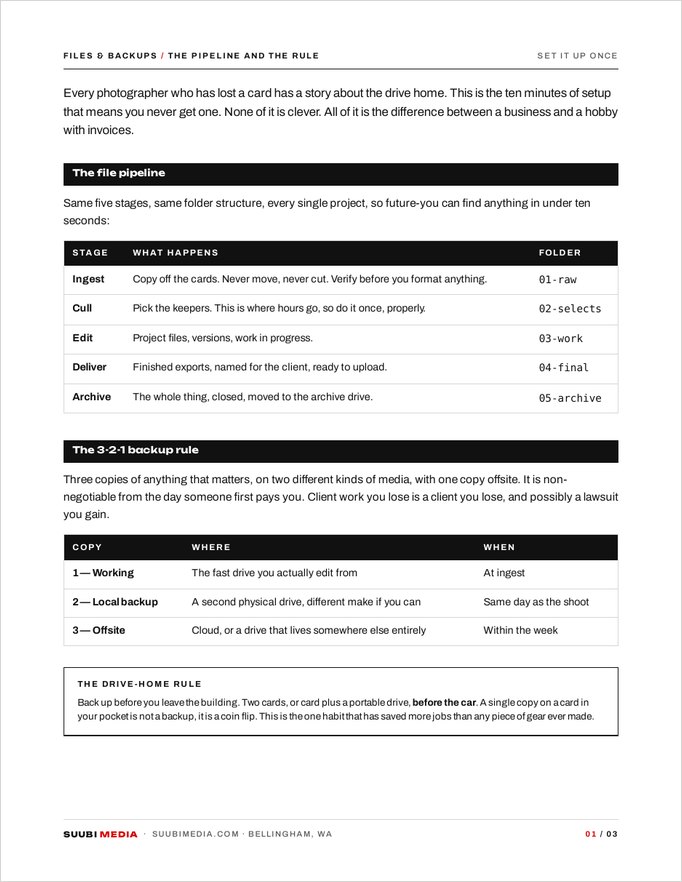
Every photographer who has lost a card has a story about the drive home. This is the ten minutes of setup that means you never get one. None of it is clever. All of it is the difference between a business and a hobby with invoices.
The file pipeline
Same five stages, same folder structure, every single project, so future-you can find anything in under ten seconds.
| Stage | What happens | Folder |
|---|---|---|
| Ingest | Copy off the cards. Never move, never cut. Verify before you format anything. | 01-raw |
| Cull | Pick the keepers. This is where hours go, so do it once, properly. | 02-selects |
| Edit | Project files, versions, work in progress. | 03-work |
| Deliver | Finished exports, named for the client, ready to upload. | 04-final |
| Archive | The whole thing, closed, moved to the archive drive. | 05-archive |
The 3-2-1 backup rule
Three copies of anything that matters, on two different kinds of media, with one copy offsite. Non-negotiable from the day someone first pays you. Client work you lose is a client you lose, and possibly a lawsuit you gain.
| Copy | Where | When |
|---|---|---|
| 1, working | The fast drive you actually edit from | At ingest |
| 2, local backup | A second physical drive, different make if you can | Same day as the shoot |
| 3, offsite | Cloud, or a drive that lives somewhere else entirely | Within the week |
The drive-home rule: back up before you leave the building. Two cards, or card plus a portable drive, before the car. A single copy on a card in your pocket is not a backup, it is a coin flip. This one habit has saved more jobs than any piece of gear ever made.
A naming convention that survives four years
Date first, so things sort chronologically. Client second. Job third. All lowercase, hyphens not spaces, no special characters that break on someone else's machine.
| Thing | Pattern | Example |
|---|---|---|
| Project folder | YYYY-MM-DD_client_job | 2026-09-19_taylor_navy-chief |
| Delivered photo | client-job-###.jpg | taylor-navy-chief-042.jpg |
| Delivered film | client-job-vN.mp4 | taylor-navy-chief-recap-v3.mp4 |
| Vertical cut | client-job-vert-N.mp4 | taylor-navy-chief-vert-2.mp4 |
| Signed paperwork | YYYY-MM-DD_client_contract.pdf | 2026-08-24_taylor_contract.pdf |
Never name anything final. You will end up with final-final-v2-USE-THIS, and so will your client. Use version numbers.
What to keep, and for how long
| What | Keep for | Why |
|---|---|---|
| Delivered finals | Forever, they are small | Portfolio, reprints, the client who lost their copy |
| Selects | Two to three years | Re-edits, a client coming back for more |
| Full raw footage | Six to twelve months, then decide | Enormous. Keep it for jobs that could recur. |
| Signed contracts and releases | Forever | The day you need one, you really need one |
| Invoices | Seven years, or whatever your accountant says | Tax |
The end-of-job checklist
0 / 9 done
Tick as you go. Your progress is kept in this browser only, so you can close the tab and come back to it.
Test a restore once a year. A backup you have never restored from is a theory. Pull one old job back from the archive and open it. Twenty minutes, and it is the only way to know the system works.
Take it with you
The full process, from brief to delivery.