
Reference
Media jargon, in plain English
8 min read · Reviewed September 2026
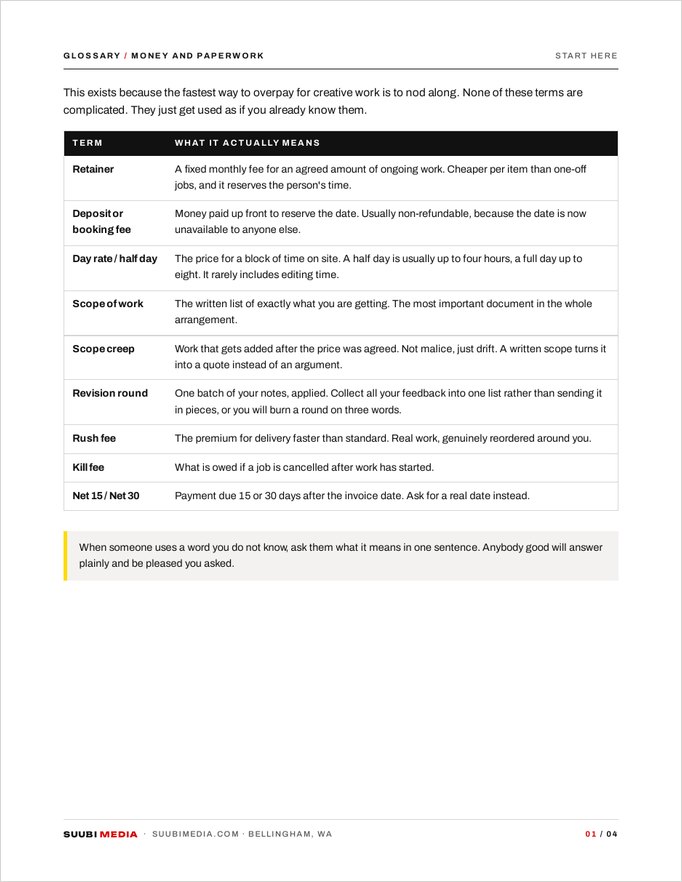
This exists because the fastest way to overpay for creative work is to nod along. None of these terms are complicated. They just get used as if you already know them, and asking feels like admitting something. So here they all are, in the order you are likely to meet them.
Money and paperwork
| Term | What it actually means |
|---|---|
| Retainer | A fixed monthly fee for an agreed amount of ongoing work. Cheaper per item than one-off jobs, and it reserves the person's time. |
| Deposit or booking fee | Money paid up front to reserve the date. Usually non-refundable, because the date is now unavailable to anyone else. |
| Day rate, half day | The price for a block of time on site. A half day is usually up to four hours, a full day up to eight. It rarely includes editing time. |
| Scope of work | The written list of exactly what you are getting. The most important document in the whole arrangement. |
| Scope creep | Work that gets added after the price was agreed. Not malice, just drift. A written scope turns it into a quote instead of an argument. |
| Revision round | One batch of your notes, applied. Collect all your feedback into one list rather than sending it in pieces, or you will burn a round on three words. |
| Rush fee | The premium for delivery faster than standard. Real work, genuinely reordered around you. |
| Kill fee | What is owed if a job is cancelled after work has started. |
| Net 15 or Net 30 | Payment due 15 or 30 days after the invoice date. Ask for a real date instead. |
Rights and ownership
This is the section that costs people money. Paying for a shoot does not automatically mean you own the photographs. In most places the photographer holds copyright as the author, and you are buying a licence. That is normal. It only becomes a problem when nobody wrote down what the licence covers.
| Term | What it actually means |
|---|---|
| Copyright | Ownership of the work itself. Usually stays with the person who created it unless a contract says otherwise. |
| Licence | Permission to use the work in agreed ways. This is what you are normally buying, not ownership. |
| Usage rights | The specifics of that licence: where, for how long, and for what purpose. |
| Perpetual | No expiry date on your licence. Worth asking for. |
| Exclusive | Nobody else can license the same images, including the photographer. Costs considerably more. |
| Commercial use | Using the work to promote a business. The line that decides whether releases are needed. |
| Model release | Written permission from a recognisable person to use their image commercially. |
| Location release | The same thing, for a property. |
| Work for hire | An arrangement where you own the copyright outright. Rare, expensive, and usually more than you need. |
On the shoot
| Term | What it actually means |
|---|---|
| Coverage window | The agreed hours the photographer is working. Not the same as when your event starts. |
| Call time | When they arrive, usually before the window starts so they can set up. |
| Golden hour | The hour after sunrise and before sunset. Soft, warm light. Worth planning around. |
| B-roll | Supporting footage: hands working, details, the room. It is what makes an edit feel like a film instead of a talking head. |
| Establishing shot | The wide frame that tells the viewer where they are. |
| Hero shot | The single best frame, the one everything else supports. |
| Second shooter | A second photographer covering angles the first one cannot be in two places for. |
| Lav or lapel mic | The small clip-on microphone. If anyone is talking on camera, you want one. |
| Vertical-safe | Framed with enough room that it can be cropped to 9:16 for Reels and Stories without cutting anyone's head off. |
| Run of show | The timed schedule for an event. Send it in advance and you get better photos. |
Editing and delivery
| Term | What it actually means |
|---|---|
| Culling | Choosing the keepers out of hundreds of frames. Genuinely takes hours. |
| Colour grade | Adjusting colour and contrast so everything looks intentional and consistent. Not a filter. |
| Retouching | Pixel-level work on individual images. Usually charged separately and only worth it on a handful of frames. |
| Raw files | Unprocessed camera files. Large, flat-looking, and not usable without editing. Rarely included, and usually you do not want them. |
| Hero piece plus cutdowns | One main film plus several short vertical versions cut from the same footage. The standard modern package. |
| Aspect ratio | The shape of the frame. 16:9 is wide, 9:16 vertical, 1:1 square, 4:5 the tall Instagram post. |
| Gallery | The private web page where your finished photos live for download. |
Web and marketing
| Term | What it actually means |
|---|---|
| Above the fold | What someone sees before scrolling. The most valuable space you own. |
| Call to action | The one thing you want a visitor to do. Call, book, order. One per page. |
| Domain | Your web address. It should be registered in your name. Always ask. |
| Hosting | The service that keeps your site online. Separate from the domain, and from whoever built it. |
| SSL or HTTPS | The padlock in the address bar. Non-negotiable, and free. |
| Responsive, mobile-first | The site works properly on a phone. Two-thirds of your visitors are on one. |
| SEO | For a local business this mostly means your Google profile, your details matching everywhere, and a fast site. |
| Impressions vs reach | Impressions is how many times a post was shown. Reach is how many separate people saw it. Reach is the honest one. |
| Engagement rate | Interactions divided by reach. Comparable across accounts of different sizes, unlike raw likes. |
| Organic vs paid | Organic is what you get for free. Paid is what you get for money. Neither replaces the other. |
If you take one thing from this page: when someone uses a word you do not know, ask them what it means in one sentence. Anybody good will answer plainly and be pleased you asked. Anybody who makes you feel stupid for asking has told you everything you need to know about working with them.
Take it with you
Genuinely. No obligation, and I would rather you understood it than hired me confused.