
Framework
How to price a job without guessing
8 min read · Reviewed September 2026
Contents
Most creators price by feel, which means they price by nerve, which means they price low. There is no single right number, but there is a way to find out whether the number you just said out loud would actually keep you in business. Do this once a year. The calculator below runs the whole thing in your browser; nothing you type leaves this page.
( costs + time ) x value x expertise = price. Floor is costs plus time. Price is the floor times what it is worth to them times what you bring that others do not.
Work out your floor
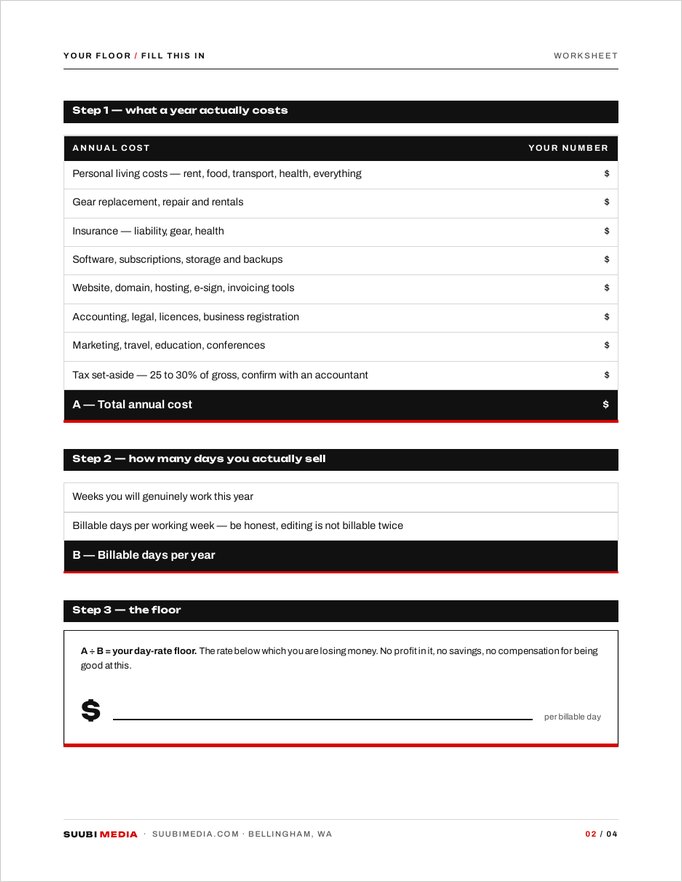
Two numbers give you the floor: what a full year of your life and business costs, and how many days you honestly sell. Fill both in and the calculator does the rest. Be pessimistic about the days; you can be pleased later.
Floor calculator
What one day has to earn
A whole year of living and business costs, together.
Most working photographers land between 60 and 120.
Your day-rate floor
Enter both numbers to see the floor, and what a four hour half day has to be.
All of this is worked out in your browser. Nothing you type is sent anywhere.
Why the day count is where the illusion breaks
A full-time working photographer does not sell 250 days a year. Between editing, admin, marketing, travel, illness and the weeks nobody calls, most people sell somewhere between 60 and 120 billable days. If you put 200 in the box above, the number it gave you is a fantasy, and it is the fantasy that made you quote low in the first place.
The four inputs, in full
- Costs. A year of running the business: gear replacement and repair, insurance, software, storage and backups, a website, accounting, travel, marketing, education, and the self-employment tax that lands like a truck in April. Set aside 25 to 30 percent of gross for tax as a working assumption and confirm it with an accountant.
- Time. Every hour the project truly takes: the call, the prep, the drive, the shoot, the cull, the edit, the revisions, the delivery admin. Beginners count the shoot and forget the other seventy percent.
- Value. What does success mean to this client, in dollars? The same recap video is worth more to a promoter filling a 1,500-capacity room than to a coffee shop. Same deliverable, different stakes, different price.
- Expertise. The multiplier you earn over time: speed, instincts, foresight, network, reputation. Score yourself one to four on each, honestly, and re-score every six months.
Price the job, not the hour
Clients do not buy hours; they buy an outcome and a risk transfer. Build a quote from these parts and show them as one number unless asked.
| Component | What it covers |
|---|---|
| Shoot time | Hours on site, at your day rate or a fraction of it |
| Pre-production | Scouting, calls, shot lists, permits, travel planning |
| Post-production | Culling and editing. For photo, budget roughly 2 to 4 hours per hour shot. For video, far more. |
| Usage licence | What they are allowed to do with it. A local shop's social media and a national ad campaign are not the same product, even if the shoot is identical. |
| Expenses | Travel, parking, assistants, rentals, permits, accommodation, at cost |
| Risk and rarity | A one-time event you cannot reshoot is worth more than a product on a table |
Your floor is private. Your anchor is public.
The floor number stays inside the company. It is the line you never quote below, not the price you advertise. What the client sees is your anchor: the standard rate, on paper, every time. And when you do choose to discount, do it visibly. Print the real rate, cross it out, name the reason. The client sees exactly what they saved, the standard rate becomes the written anchor for every future booking, and the discount reads as generosity instead of desperation.
The rules that matter more than the number
- Say the number and then stop talking. The silence after a price is uncomfortable for exactly the length of time it takes an amateur to discount it.
- Never lower a price without lowering the scope. Fewer images, fewer hours, narrower usage. A discount for nothing teaches the client your prices are fiction.
- Charge for usage, not just time. It is the single biggest gap between people making a living at this and people not.
- Have three tiers. Most people pick the middle one, and the top one makes the middle one look sensible.
- Raise your rate when you are turning work down, not when you feel you deserve it.
- Put the price in writing the same day you say it out loud.
On working for free
Do it deliberately or not at all. Free work is worth doing when you choose the concept, keep the images, and it fills a real hole in your portfolio. It is not worth doing for exposure, for a business that is paying everyone else in the room, or because you are afraid to ask. The difference is who is directing it.
Take it with you
Second shooters, editors and assistants, project by project.