
Guide
Gear that actually matters
8 min read · Reviewed September 2026
Contents
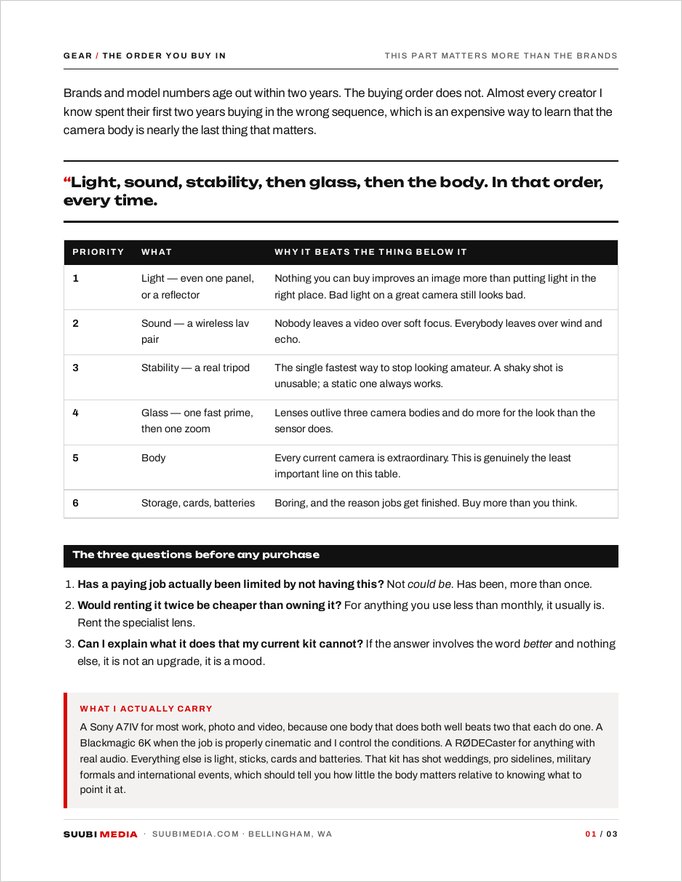
Brands and model numbers age out within two years. The buying order does not. Almost every creator I know spent their first two years buying in the wrong sequence, which is an expensive way to learn that the camera body is nearly the last thing that matters.
Light, sound, stability, then glass, then the body. In that order, every time.
| Priority | What | Why it beats the thing below it |
|---|---|---|
| 1 | Light, even one panel or a reflector | Nothing you can buy improves an image more than putting light in the right place. Bad light on a great camera still looks bad. |
| 2 | Sound, a wireless lav pair | Nobody leaves a video over soft focus. Everybody leaves over wind and echo. |
| 3 | Stability, a real tripod | The fastest way to stop looking amateur. A shaky shot is unusable; a static one always works. |
| 4 | Glass, one fast prime then one zoom | Lenses outlive three camera bodies and do more for the look than the sensor does. |
| 5 | Body | Every current camera is extraordinary. Genuinely the least important line on this table. |
| 6 | Storage, cards, batteries | Boring, and the reason jobs get finished. Buy more than you think. |
Three questions before any purchase
- Has a paying job actually been limited by not having this? Not could be. Has been, more than once.
- Would renting it twice be cheaper than owning it? For anything you use less than monthly, it usually is. Rent the specialist lens.
- Can I explain what it does that my current kit cannot? If the answer involves the word better and nothing else, it is not an upgrade, it is a mood.
What I actually carry
A Sony A7IV for most work, photo and video, because one body that does both well beats two that each do one. A Blackmagic 6K when the job is properly cinematic and I control the conditions. A RODECaster for anything with real audio. Everything else is light, sticks, cards and batteries. That kit has shot weddings, pro sidelines, military formals and international events, which should tell you how little the body matters relative to knowing what to point it at.
Starting out
- Camera: a used full-frame body one or two generations old. The bargain of the industry. Nobody has ever asked me what I shot on.
- Lens: one fast prime, around 35mm or 50mm equivalent. One lens forces you to learn framing.
- Sound: a budget wireless lav pair. This purchase changes your work more than the camera did.
- Light: a reflector, and windows. Genuinely.
- Support: a solid tripod. Not the twenty dollar one that wobbles.
- Storage: two portable drives, and more cards than feels necessary.
Working
- Add a zoom in the 24 to 70 range. The lens that lives on the camera at events.
- Add a second body. Not for the specs. For the wedding where the first one dies.
- Add a real light, battery powered, with a softbox.
- Add a gimbal only if movement is actually part of what you sell.
- Add a fast telephoto if you shoot sport or events. This is where the money goes and it is worth it.
- Upgrade the computer before the camera. Editing time is billable time you are losing.
Established
- A cinema body, if and only if clients are asking for things your hybrid cannot deliver.
- Duplicates of everything critical. Two of every cable, mic and battery type. Redundancy is the actual professional upgrade.
- Proper lighting and grip, stands and modifiers, which nobody photographs for Instagram and everybody notices in the result.
- Insurance and a real case. Boring, and the difference between a bad day and a closed business.
What not to buy, at any level
- A drone, until a client has asked for aerials twice and you have checked the licensing where you work.
- Filters beyond a good variable ND. The rest is fixable in the edit.
- A second editing app. Mastery of one beats subscriptions to three.
- Anything because a review video called it a game changer. Nothing on this list is a game changer. The game is knowing what to point it at.
The honest summary: your first ten paid jobs will be limited by light, sound and knowing where to stand. None of those are solved by spending money. Buy the cheapest kit that does not fail, use it until it genuinely stops you, then upgrade the one thing that stopped you.
Take it with you
Gear is a cost. The floor calculator is where it turns into a rate.