
Guide
How to hire a photographer without getting burned
9 min read · Reviewed September 2026
Contents
I make my living taking these bookings, so read this with the appropriate scepticism. But a client who knows what they are buying is a better client, gets a better result, and does not end up in a fight three weeks later. That is worth more to me than a job won on confusion. Everything here applies whether you hire me or somebody else.
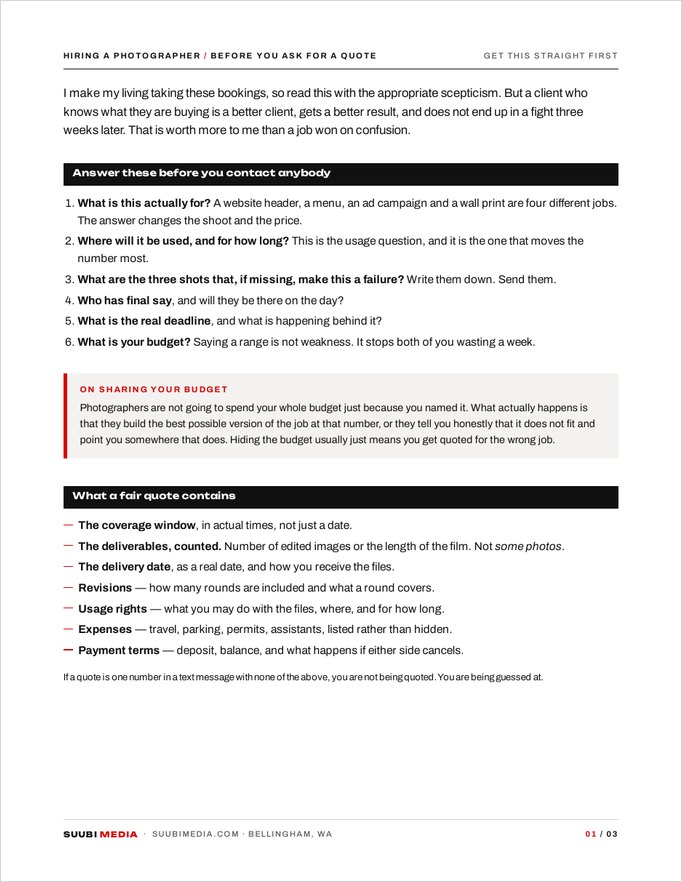
Answer these before you contact anybody
- What is this actually for? A website header, a menu, an ad campaign and a wall print are four different jobs. The answer changes the shoot and the price.
- Where will it be used, and for how long? This is the usage question, and it moves the number more than anything else.
- What are the three shots that, if missing, make this a failure? Write them down. Send them.
- Who has final say, and will they be there on the day?
- What is the real deadline, and what is happening behind it?
- What is your budget? Saying a range is not weakness. It stops both of you wasting a week.
On sharing your budget: photographers are not going to spend the whole thing just because you named it. What actually happens is they build the best version of the job at that number, or tell you honestly it does not fit and point you somewhere that does. Hiding the budget usually just means you get quoted for the wrong job.
What a fair quote contains
0 / 7 done
Tick as you go. Your progress is kept in this browser only, so you can close the tab and come back to it.
If a quote is one number in a text message with none of the above, you are not being quoted. You are being guessed at.
Usage rights, in plain words
This is the single most misunderstood thing in the industry, and the one that costs people money. Paying for a photo shoot does not automatically mean you own the photographs. In most places the photographer holds the copyright as author of the work, and what you are buying is a licence to use the images in agreed ways. That is normal, it is not a trick, and it only becomes a problem when nobody writes it down.
| Kind of use | What it covers | What to ask for |
|---|---|---|
| Personal | Prints, your own social, sharing with family | Fine for a portrait or a private event |
| Business and marketing | Your website, socials, brochures, signage, email | What almost every business actually needs. Ask for it explicitly. |
| Paid advertising | Anything you put money behind, plus billboards and print ads | Usually priced separately. Say so up front and it costs less than adding it later. |
| Third-party or resale | Giving files to a sponsor, brand, venue or publication for their own use | Almost never included by default. Ask before you promise it to anyone. |
Five more things to settle in writing
- How long the licence lasts. Perpetual is common and worth asking for.
- Whether you can edit or crop. Cropping and straightening are usually fine; heavy filters usually are not.
- Whether they can use the photos in their portfolio. Most will want to. If your shoot is sensitive, say so before the day, not after.
- Whether you get raw or unedited files. Usually no, and usually for good reason. If you genuinely need them, expect to pay.
- How long the gallery stays live, and what it costs to restore later. Download and back up your files the week you get them.
Six things that should make you walk
- They resist any written agreement. We don't really need a contract, do we? is the loudest possible signal. A contract protects you at least as much as them.
- No deposit, no paperwork, no invoice. Casual on money means casual on delivery.
- A portfolio that never shows a full job, only single hero frames. Ask to see one complete gallery from one real client.
- They will not name a delivery date. Soon is how you end up chasing someone in March.
- They dodge the usage question. If they cannot explain in one sentence what you are allowed to do with the files, they have not thought about it, and you will find out later.
- Disrespect before the deposit. Late replies, vague answers, pressure. It never improves after they have your money.
One thing that is not a red flag: a photographer who asks a lot of questions before quoting. That is the good version. The ones who quote instantly without asking what it is for are guessing.
How to brief well
The single biggest thing you can do to get a better result is send a real brief. Ten minutes, and it changes the entire shoot. The download below is a one-page form covering all of it, but at minimum send: what it is for and where it will be used, the three shots that must exist, the date and coverage window, parking and who to call on arrival, and anyone who should not be photographed.
One more, and it is free: tidy the space before they arrive. Move the boxes, the cables, the mop bucket. Ninety percent of retouching is tidying that could have been done in ten seconds, and no amount of editing makes a cluttered room look like a calm one.
Take it with you
The Suubi rate card is published in full, so you can compare it against anything else you are quoted.