
Template
Invoices that actually get paid
7 min read · Reviewed September 2026
Contents
An invoice is not a receipt. A receipt records something that already happened. An invoice is an instruction, and a vague instruction gets ignored for a month. Most late payments in this business are not refusals, they are inbox failures caused by a document that did not make paying obvious. Here is what fixes that.
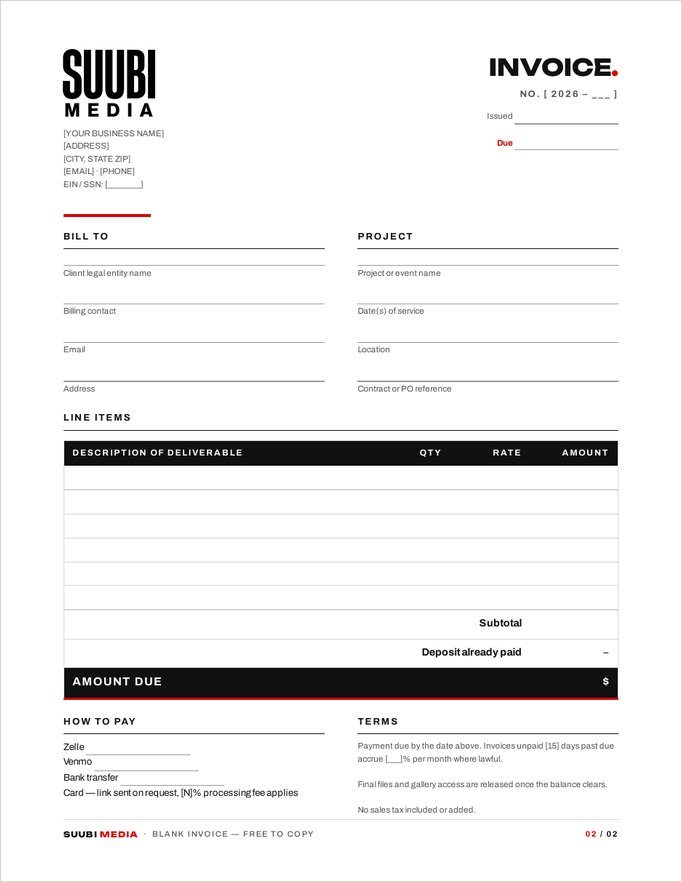
The eight things every invoice must carry
- The word INVOICE, large, at the top. Accounts payable departments sort by that word.
- An invoice number that never repeats. 2026-014 is enough. Sequential numbers make you look like a company and make April survivable.
- Your legal or business name, address and EIN or SSN. A business paying you over $600 in a year needs it for a 1099 and will chase you for it in January anyway.
- The client's legal entity name, not the person who hired you, plus a billing contact and email.
- Line items that describe deliverables, not moods. Event coverage, four hours on site beats photography services.
- A due date, as an actual date. Net 15 is jargon that lets a slow payer pretend. Due September 18, 2026 is not.
- Exactly how to pay you, every handle spelled out. Each extra step between reading and paying costs days.
- The late fee, if you charge one, stated in the same size type as everything else.
The three lines that actually move money
- Amount due, one number, in the biggest type on the page. Nobody should have to add anything up.
- The due date, written as a real date. Ambiguity is a payment delay with a friendly face.
- Deposit already paid, shown and subtracted. It proves the math and reminds them you are already underway.
Rules that keep invoices from going stale
- Send it the same day you deliver. An invoice sent a week later reads as an afterthought and gets treated like one.
- Deposit before the date, balance on or before delivery. Fifty-fifty is the default for a reason. If a client will not pay a deposit, they are not a client yet.
- Never let final files leave before the balance clears unless you decided to, on purpose, for a reason you could say out loud.
- Follow up on day one past due, not day thirty. One short, friendly, factual line.
- Charge the late fee once you have written it down. A late fee you never apply is a sentence, not a policy.
- Keep every invoice as a PDF in one folder named by number. Your accountant in April is a person you are being kind to today.
The chase, when it goes past due
Hey [name], hope the [event / gallery] is going down well. Quick admin note: invoice 2026-014 for $[amount] came due yesterday. No stress if it is already moving, just let me know and I will stop watching the inbox. Payment details are on the invoice, happy to resend it.
Hi [name], following up on invoice 2026-014, $[amount], now two weeks past due. Can you let me know where it sits on your side and when I should expect it? If something has changed, tell me and we will work it out. Otherwise the terms carry a [rate]% monthly late charge from [date], and I would rather not add that.
Three worked examples
The download below has three filled-in invoices with the client names removed: an event film with a visible crossed-out discount, a business photo day with add-ons, and a website build billed in two stages. They are examples, not records. The layout and the line-item logic are exactly what Suubi sends, and the figures come off the published rate card rather than any particular job, so read them as a shape to fill rather than a claim about what anybody paid.
Line items should be deliverables, not moods. When a line item is a deliverable, the client ticks it off. When it is a mood, they question it.
Set aside 25 to 30 percent of everything that lands, in a separate account, the day it lands. Confirm the number with an accountant for your situation. It is the habit that separates a business from a scare.
Use it under your own name. Download the Word version, put your business at the top, delete my footer, and send it as yours. You do not need to credit me or ask permission. The only thing I would ask is that you do not resell it as your own template product.
Take it with you
Word + PDF
Blank invoice
A blank fillable invoice plus the eight things every invoice has to carry. Word to fill in, PDF to see the finished shape. Yours to rebrand.
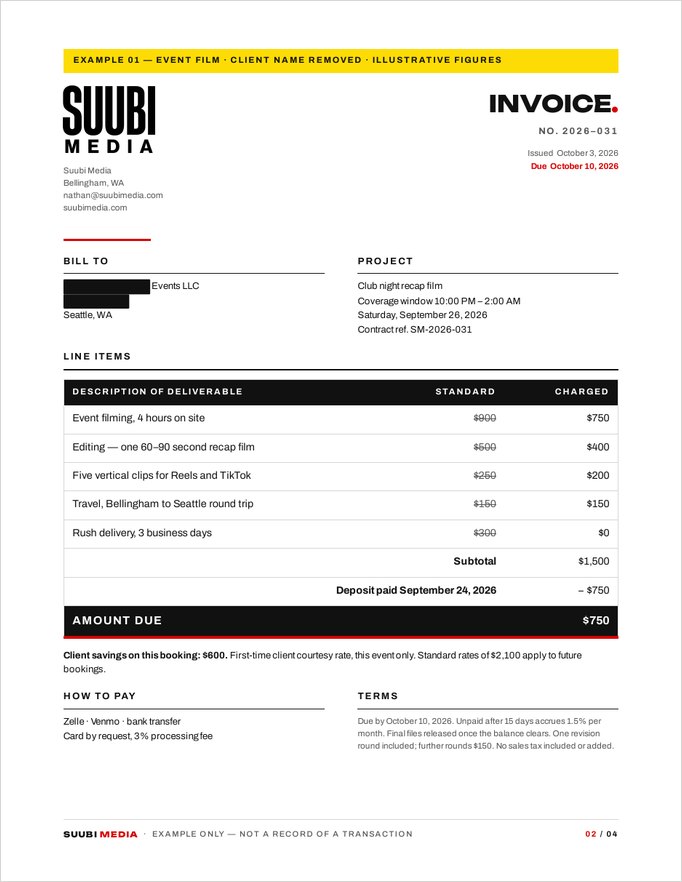
Every figure in the examples comes off the published Suubi card.
Templates here are starting points, not legal advice. Have a lawyer licensed in your state review anything you plan to sign.